Free · No signup · PDF download
Invoice Maker for a Construction Business
Construction bills in valuations, not one-off invoices. Here is how an application for payment is structured, how retention and variations are shown, and where the money gets lost.
- Applications and cumulative valuations
- Retention and previous payments
- Variations itemised
- Instant A4 PDF, no account
Online Invoice Generator for Construction
Fill in the invoice or application below — valuation, less previously certified, retention — then download the PDF or print it. Nothing you type is sent to us.
Download or print
Invoice settings
 Create invoices regularly?
Invoices, receipts, quotations and waybills on your phone.
Get the Android app| $0.00 |
- No signup or login
- Instant PDF download
- Processed in your browser
- Free, with no invoice limit
01
Applications for payment, not just invoices
On anything beyond small domestic work, construction does not bill in single invoices. It bills in periodic applications for payment: a valuation of the work completed to date, less what has already been certified and paid. If your contract works that way, your document has to show the running arithmetic, not just this month’s figure.
| Line | What it shows |
|---|---|
| Contract sum | The agreed total, plus approved variations to date. |
| Value of work completed to date | Cumulative, not just this period. |
| Materials on site | Delivered but not yet installed, where the contract allows it. |
| Less retention | The percentage held back, stated explicitly. |
| Less previously certified | Everything already paid or certified. |
| Net amount now due | The figure this application is asking for. |
Every one of those lines can be produced as line items with the earlier amounts entered as negatives, so the document shows how the figure was reached rather than presenting it as a bare total.
02
Payment notices and dates
Many countries regulate construction payment: statutory payment periods, due dates, payment notices and pay-less notices, with strict deadlines on each side. Getting the dates on your application right is not administrative detail — in some jurisdictions a correctly served application that is not answered with a valid notice becomes payable in full. Find out what applies to your contract, and put the due date and the final date for payment on the document.
03
Variations and instructions
Number every variation, price it before you carry it out where you possibly can, and reference the instruction and its date on the application. On a job with thirty variations, the ones that get paid are the ones with a paper trail. Keep a running variation schedule and reconcile it against what you have applied for.
04
Retention
Typically a percentage of each valuation, half released at practical completion and the balance at the end of the defects liability period. Show the deduction on every application, and diarise both release dates. Retention is the money most often left uncollected in construction, purely because nobody chased it.
05
Subcontractor and supplier chains
- Match your terms up and down the chain. Paying suppliers on Net 30 while being paid on Net 60 is a cash flow problem you have created for yourself.
- Check tax deduction schemes. Several countries operate withholding schemes for construction payments — the contractor deducts tax at source and your invoice needs to reflect it. Confirm your status before invoicing.
- Reverse charge rules for VAT or GST apply to construction services in some jurisdictions, changing who accounts for the tax. Where they apply, the invoice must say so.
- Keep delivery records. Materials on site claims need proof of delivery. See the waybill maker guide.
Construction payment law, withholding schemes and reverse charge rules differ substantially between countries and change over time. Treat the points above as things to confirm with your accountant or contract administrator, not as advice.
Documents on site, not back at the office
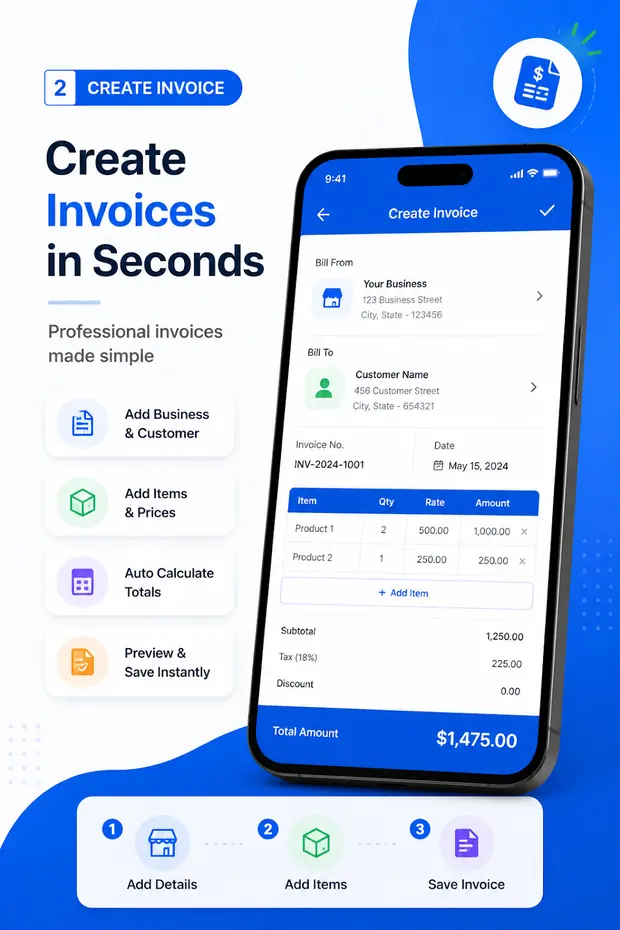
Invoice & Quotation Generator creates invoices, quotations, receipts and waybills on Android, so a valuation, a delivery note or a variation can be issued from where the work is.
- Invoices and quotations with detailed line items
- Waybills for deliveries to site
- Taxes, discounts and automatic totals
- Export as PDF, print or share
- Free, with unlimited documents
Make the document now
Free invoice, receipt, quotation and waybill tools
Every tool runs in your browser with no signup and downloads an A4 PDF. Your business details are kept in this browser and shared between them.
Free tool
Free invoice creator
Invoices with tax, discount, logo and every currency, as an A4 PDF.
Free tool
Receipt maker
Payment method, amount received, balance due and a PAID stamp.
Free tool
Quotation maker
Valid-until date, deposit to proceed, scope and terms.
Free tool
Waybill maker
Sender, receiver, carrier, packages and weight for a delivery.
Free tool
Bill generator
Itemised bills for shops, restaurants and services.
Free tool
Tax invoice generator
GST, VAT or sales tax as its own line, per invoice or per item.
Free tool
Invoice templates (Word)
Six editable .docx invoice layouts to download.
Free tool
Android app
Invoices, receipts, quotations and waybills on your phone.
FAQ
Questions
What is an application for payment?
A periodic valuation of work completed to date, less retention and less amounts already certified, producing the net sum now due. It is the standard billing mechanism on construction contracts above small works.
How is it different from an invoice?
An invoice states a fixed sum for completed work. An application values cumulative progress and shows the arithmetic. In many contracts the invoice is only issued once the application has been certified.
How should retention be shown?
As an explicit deduction on every application, with the percentage, the amount and the release dates. Keep your own record of both release dates.
How do I invoice a variation?
Reference the instruction number and its date, price it separately, and carry it on your variation schedule so the cumulative contract sum stays reconciled.
Do construction payments have special tax rules?
In several countries, yes — withholding schemes and reverse charge rules for VAT or GST are common in construction. What applies depends on where you work and your registration status. Check with your accountant before issuing.