Free · No signup · PDF download
Invoice Maker for Contractors
Labour, materials, variations, stage payments and retention — a contractor’s invoice has more moving parts than most. Here is how to lay each one out.
- Labour and materials on separate lines
- Variations itemised
- Deposit and retention deductions
- Instant A4 PDF, no account
Online Invoice Generator for Contractors
Fill in the contractor invoice below — labour, materials and variations as separate lines — then download the PDF or print it. Nothing you type is sent to us.
Download or print
Invoice settings
 Create invoices regularly?
Invoices, receipts, quotations and waybills on your phone.
Get the Android app| $0.00 |
- No signup or login
- Instant PDF download
- Processed in your browser
- Free, with no invoice limit
01
Separate labour from materials
The most useful thing a contractor can do on an invoice is split labour and materials into their own lines. It shows the customer where the money went, it makes a variation easy to price, and it stops an argument about your day rate turning into an argument about the whole bill.
| Description | Qty | Rate | Amount |
|---|---|---|---|
| Labour — second fix, 4–8 March 2 operatives, 4 days | 64 | 38.00 | 2,432.00 |
| Materials — per attached schedule Supplied at cost plus 10% handling | 1 | 1,845.60 | 1,845.60 |
| Skip hire and waste disposal | 1 | 260.00 | 260.00 |
| Variation VO-03 — additional socket runs Instructed on site 6 March, confirmed by email | 1 | 420.00 | 420.00 |
| Less deposit received 24 February | 1 | -1,500.00 | -1,500.00 |
02
Progress billing on longer jobs
No contractor should be funding a customer’s project. On anything running more than a couple of weeks, agree a payment schedule before you start and invoice against it.
- Deposit or mobilisation payment before work begins — typically covering materials you have to buy in.
- Stage payments tied to identifiable, verifiable points: first fix complete, watertight, plastered.
- Final payment on practical completion, with any retention shown explicitly.
Each stage invoice should state the stage, the percentage or amount of the contract sum it represents, what has been invoiced to date and what remains. A customer who can see the running total queries far less.
03
Variations are where contracts go wrong
Extra work agreed verbally on site is the most common cause of a disputed final invoice. Give every variation a number, confirm it in writing before you carry it out — a text message counts — and put it on the invoice as its own line, referencing the instruction and its date. If the customer can see exactly what they asked for and when, the extra is far harder to argue with.
04
Retention
On commercial work a percentage is often held back until a defects period ends. Show it on the invoice as a deduction with the release date, and diarise that date — retention is money that is routinely forgotten by the party owed it. Do not let it disappear into the final total unmarked.
05
Materials: at cost, or marked up?
Both are legitimate; what causes friction is not saying which. If you mark materials up, either say so (“cost plus 10% handling”) or quote a supply-and-fit rate per unit and bill that. What you should avoid is presenting a marked-up figure as though it were a supplier receipt.
06
Terms that suit contracting
- Shorter terms than professional services — Net 7 or Net 14 for domestic work.
- State that materials remain your property until paid for, if your contract says so.
- Note who is responsible for site access and delays, and how standing time is charged.
- For domestic customers, be aware that consumer contract rules in your country may give cancellation rights. Check what applies before relying on your terms.
Invoice from the site, not from the office
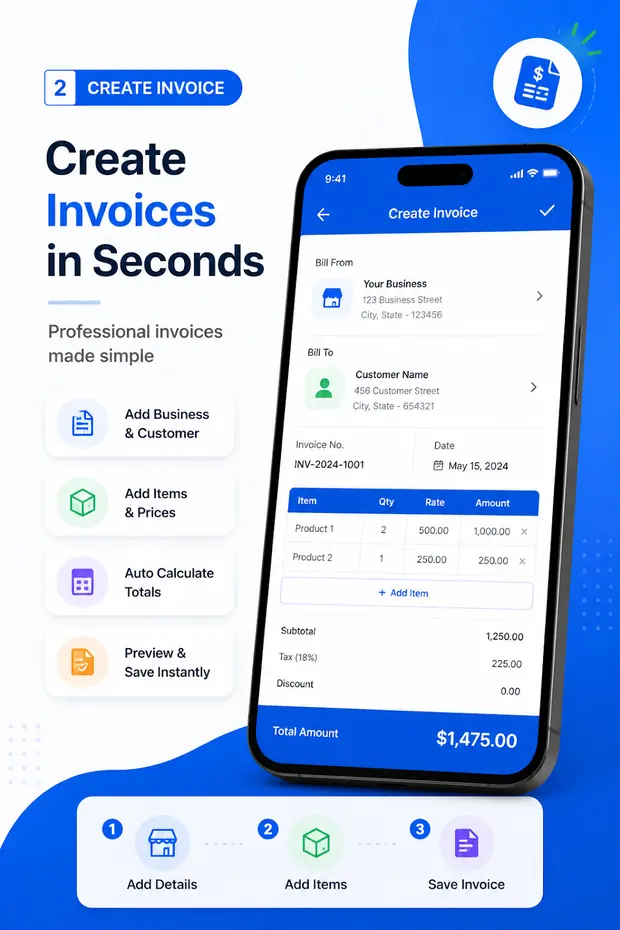
Invoice & Quotation Generator creates invoices, quotations and receipts on Android, so the invoice can be issued while you are still on the job.
- Quotations on site, invoices on completion
- Line items for labour, materials and variations
- Taxes, discounts and automatic totals
- Export as PDF, print or share
- Free, with unlimited documents
Make the document now
Free invoice, receipt, quotation and waybill tools
Every tool runs in your browser with no signup and downloads an A4 PDF. Your business details are kept in this browser and shared between them.
Free tool
Free invoice creator
Invoices with tax, discount, logo and every currency, as an A4 PDF.
Free tool
Receipt maker
Payment method, amount received, balance due and a PAID stamp.
Free tool
Quotation maker
Valid-until date, deposit to proceed, scope and terms.
Free tool
Waybill maker
Sender, receiver, carrier, packages and weight for a delivery.
Free tool
Bill generator
Itemised bills for shops, restaurants and services.
Free tool
Tax invoice generator
GST, VAT or sales tax as its own line, per invoice or per item.
Free tool
Invoice templates (Word)
Six editable .docx invoice layouts to download.
Free tool
Android app
Invoices, receipts, quotations and waybills on your phone.
FAQ
Questions
How should a contractor invoice for labour and materials?
As separate lines. Labour with hours or days and a rate; materials either at cost with the handling charge stated, or as a supply-and-fit rate per unit. Waste disposal, plant hire and permits get their own lines too.
What is progress billing?
Invoicing in stages as a job proceeds, against a schedule agreed before work starts. Each invoice covers a defined stage and states what has been invoiced so far and what remains.
How do I invoice for extra work?
Number the variation, get the instruction in writing before you do it, and invoice it as its own line referencing the instruction and the date. Never fold it silently into an existing line.
Should I take a deposit?
For any job where you buy materials in advance, yes. It covers your outlay and confirms the customer is committed. Invoice it separately and deduct it on the final invoice.
How do I show retention on an invoice?
As an explicit deduction with the percentage, the amount and the date it becomes due. Keep your own record of the release date — retention is easily forgotten.