Free · No signup · PDF download
Invoice Maker for Electricians
Call-out, labour, parts, testing and certification — each belongs on its own line, with the date you attended. Here is how an electrical invoice should read.
- Call-out, labour and parts lines
- Certificates noted on the invoice
- Every currency, your logo
- Instant A4 PDF, no account
Online Invoice Generator for Electricians
Fill in the invoice below — call-out, labour and itemised parts — then download the PDF or print it from the van. Nothing you type is sent to us.
Download or print
Invoice settings
 Create invoices regularly?
Invoices, receipts, quotations and waybills on your phone.
Get the Android app| $0.00 |
- No signup or login
- Instant PDF download
- Processed in your browser
- Free, with no invoice limit
01
The call-out charge, and how to present it
A call-out charge is the most queried line on an electrical invoice, and almost always because the customer did not know it existed. Quote it when the job is booked, state what it covers — typically attendance plus the first period on site — and put it on the invoice as its own line with the arrival time. Once it is visible and was disclosed, it stops being contentious.
02
Labour
Hours on site with the rate, and the dates worked. Where you charge different rates for standard hours, evenings, weekends or emergency attendance, use a separate line for each rather than an averaged figure — a customer who can see which hours were charged at which rate can check it.
03
Materials and parts
Itemise anything of significance: consumer units, RCBOs, cable by the metre, accessories, fittings. Consumables can reasonably be grouped as a sundries line, but a customer is entitled to see the parts that carry real cost. If you mark parts up, either say so or bill a supply-and-fit price per item.
04
Testing, certification and notification
Certification is chargeable work and takes real time. Show it explicitly — an installation certificate, a minor works certificate, an EICR, or notification of notifiable work to the relevant building control scheme in your country. Naming the certificate on the invoice also gives the customer a document reference they may need when they sell or let the property.
| Description | Qty | Rate | Amount |
|---|---|---|---|
| Call-out and first hour on site Attended 14 March, 08:40 | 1 | 85.00 | 85.00 |
| Labour — standard rate, additional hours | 3.5 | 52.00 | 182.00 |
| Consumer unit, 10-way, metal clad | 1 | 148.00 | 148.00 |
| RCBO 32A type B | 4 | 21.50 | 86.00 |
| Twin and earth cable 2.5mm² | 28 | 1.85 | 51.80 |
| Electrical installation certificate and testing | 1 | 75.00 | 75.00 |
| Sundries and fixings | 1 | 18.00 | 18.00 |
05
Record the service dates and the location
Put the date of attendance and the property address on the invoice, not just the billing address. Landlords and letting agents often hold several properties and cannot allocate a bill without it, and for any warranty question later the date of the work is the first thing anyone asks for.
06
Emergency and out-of-hours work
Charge it as its own line at its own rate and label it as such. Where you attended outside normal hours, showing the arrival time removes any question about why the rate differs.
07
Getting paid on domestic work
- Invoice before you leave. For small jobs, an invoice handed over on the day is paid far more often than one emailed the following week.
- Short terms. Net 7 is reasonable for domestic work; on account for trade customers.
- Take a materials deposit on anything where you buy parts in advance.
- Issue a receipt when paid, particularly for cash. See the receipt maker guide.
Invoice before you leave the job
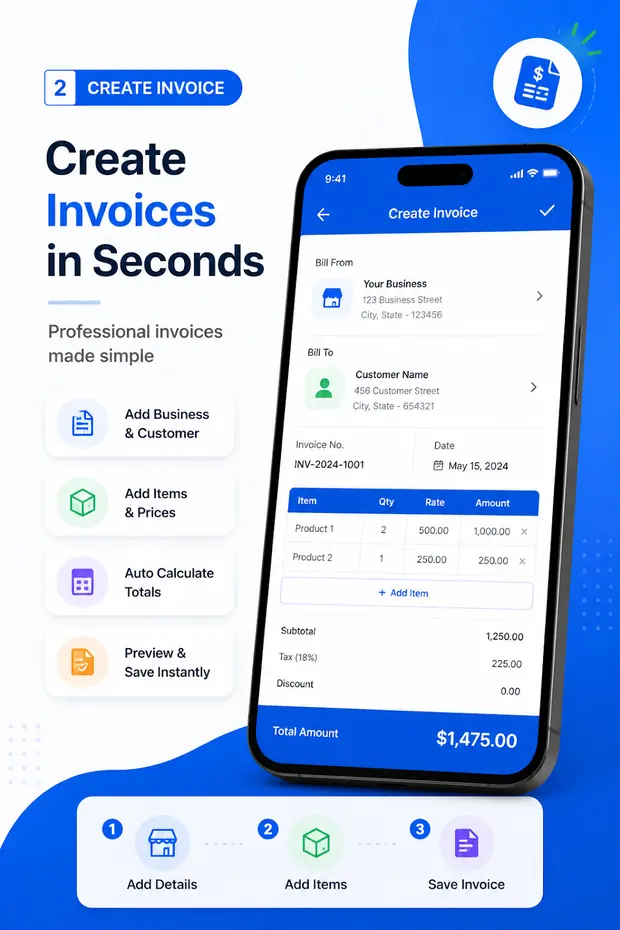
Invoice & Quotation Generator creates the invoice on your phone while you are still on site, exports it as a PDF and lets you send it or hand over a printed copy.
- Line items for call-out, labour, parts and testing
- Quotations for larger jobs, receipts when paid
- Customer and property details saved for repeat work
- Export as PDF, print or share
- Free, with unlimited documents
Make the document now
Free invoice, receipt, quotation and waybill tools
Every tool runs in your browser with no signup and downloads an A4 PDF. Your business details are kept in this browser and shared between them.
Free tool
Free invoice creator
Invoices with tax, discount, logo and every currency, as an A4 PDF.
Free tool
Receipt maker
Payment method, amount received, balance due and a PAID stamp.
Free tool
Quotation maker
Valid-until date, deposit to proceed, scope and terms.
Free tool
Waybill maker
Sender, receiver, carrier, packages and weight for a delivery.
Free tool
Bill generator
Itemised bills for shops, restaurants and services.
Free tool
Tax invoice generator
GST, VAT or sales tax as its own line, per invoice or per item.
Free tool
Invoice templates (Word)
Six editable .docx invoice layouts to download.
Free tool
Android app
Invoices, receipts, quotations and waybills on your phone.
FAQ
Questions
How do I invoice a call-out charge?
As its own line, stating what it covers and the time you attended, and having disclosed it when the job was booked. A call-out that appears for the first time on the invoice is the most common cause of a disputed electrical bill.
Should I itemise every part?
Itemise anything with meaningful cost — consumer units, breakers, cable, accessories. Small consumables can be grouped as sundries.
Can I charge for testing and certification?
Yes. It is chargeable work and it takes time. Naming the certificate on the invoice also gives the customer the reference they may need later.
What payment terms suit electrical work?
Short ones for domestic customers — on the day or Net 7. Trade and landlord accounts typically run Net 14 or Net 30.
Should the invoice show the property address?
Yes, whenever it differs from the billing address. Landlords and agents cannot allocate a bill without knowing which property it relates to.